


A Tangled Web of Risky Apollo Related Investments Dominate Athene’s Risk
Tattooed Teenage Alien Fighters from Beverly Hills (TTAFBH)
One of Athene’s largest single line items in their 2025 year end statutory filings is Apollo Aligned Alternatives (AAA), an $11B Cayman domiciled entity that itself holds a variety of investments. Notably, Cayman is a domicile that has come under heavy criticism by none other than Apollo.
The oblique reference above is what one finds when googling for the second largest AAA investment: “AAA Centaur Apollo.” TTAFBH obviously has nothing to do with Athene, but it is an amusing cultural pastiche that I was today years old when I learned of it. But alas, I was able to learn nothing about AAA Centaur Apollo. Fortunately I had more success with other AAA holdings.
It is also small window into the opaque entities littering Athene’s balance sheet which are far too cloaked in secrecy to enable a real understanding of Athene’s true risk. When Tattooed Teenage Alien Fighters from Beverly Hills are less obscure than a $600M investment by a large insurance company, maybe we should wake the f@#k up and pay attention.
I have covered Athene in depth over the past two years, mostly focusing on their Fixed Income securities (Schedule D in their statutory filings). Last month I reported on their $30B exposure to BDC debt and CLOs. Coincidentally (or perhaps not), Athene covered these very products in a special report released this month. I understand how CLOs and BDC debt work as well as the risks they present.
The investments I cover in this article are far more opaque.
In this two-part article, I cover $23B of Apollo sourced investments that presents a degree of complexity, risk and opacity that requires urgent attention – by regulators, financial advisors, rating agencies and policyholders.
In Part 1, I will cover AAA (the dominant asset in Athene’s alternatives holdings/Schedule BA) and in Part 2 I will describe several large investments of concern from Schedule D (fixed income investments) that are backed by equity, yet carry investment grade ratings which require a scant amount of regulatory capital.
Such classification sleight of hand – from equity to IG credit- can reduce required capital by over 90%. The largest of such investments - AMAPS - has been branded by Apollo as a new-age form of CLO backed by investment grade assets, yet NAIC classifies it as Equity Backed ABS. But more on that in Part 2.
My team recently greatly enhanced our data extraction process from insurance regulatory filings including Athene’s nearly 10,000-page filing and extracted both their Schedule D (largely Fixed Income Investments) and Schedule BA (joint venture investments and similar).
Side note: Kudos to Apollo/Athene for disclosing their entire statutory filings – many insurance companies don’t disclose publicly at all or just publish a summary version.
Overview of Athene’s Nesting Dolls
The below table summarizes the investments I will cover.
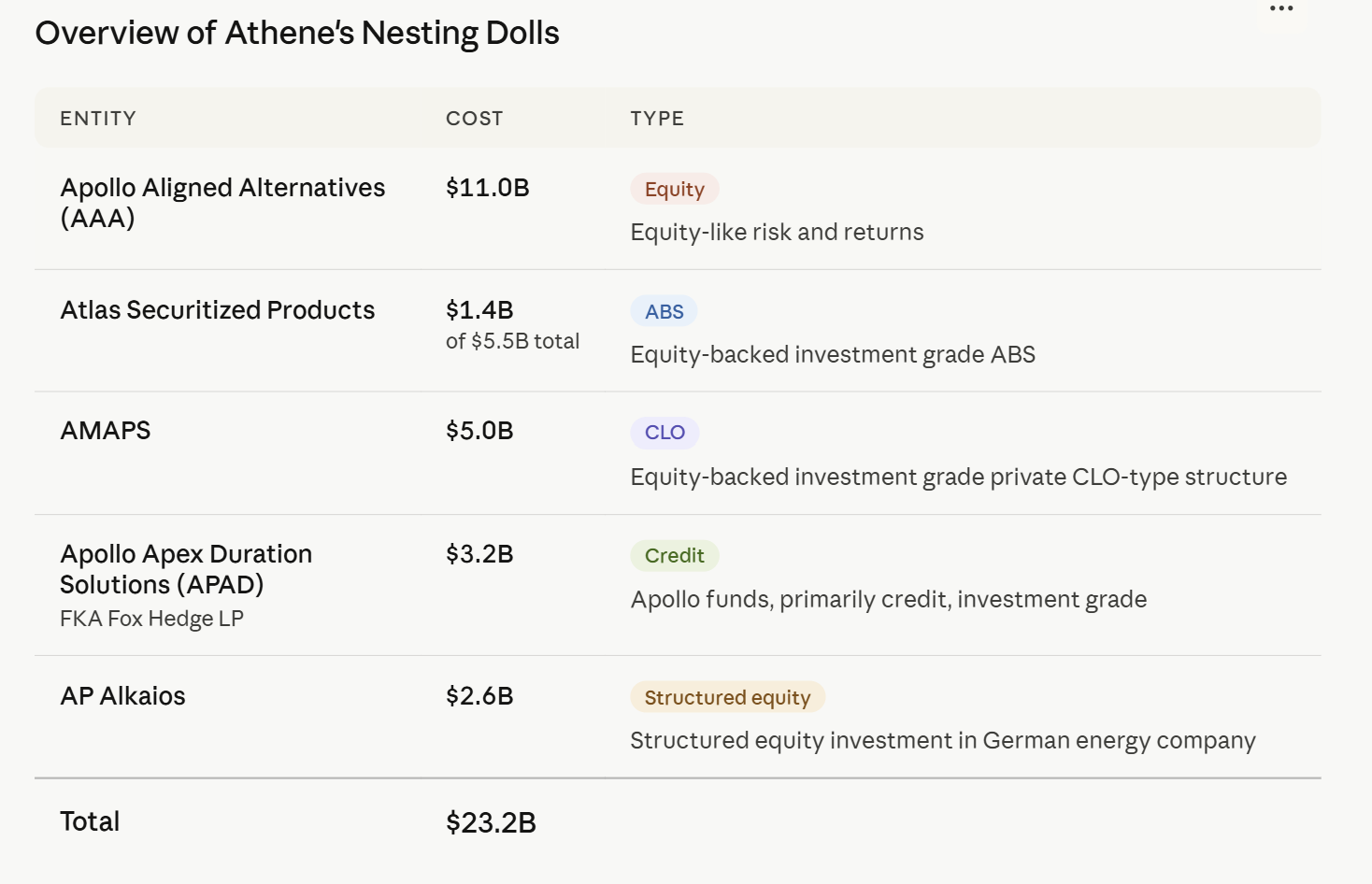
This article sources information from Athene’s statutory filings as well as their 10K. Further, Athene released new presentations this month offering more detail on their Apollo-related and alternatives investments.
Side Note: The additional disclosure is appreciated. However, I wonder if Apollo isn’t executing the magician’s equivalent of “nothing up my sleeve.” Revealing just enough to misdirect the audience from what is really happening. The illusion of transparency. The information is useful but only provides a patina of insight and not enough to truly understand the risk.
The Ties That Bind – This Month Athene Revealed Far Higher Exposure to Apollo Assets
I previously argued that my analysis revealed that Athene’s Apollo affiliated assets are far higher than the 17% disclosed by Athene, and that the true number was over 50%.
However, even my conservative estimate proved too low. Athene revealed this month that 75% of Athene’s assets are Apollo originated, despite only 17% formally classified as “Affiliated” and 13% as “Related Party” based on insurance regulatory and accounting standards, respectively.
Overview of Athene’s $11B AAA Alternatives Vehicle
Buried on page 5814 of Athene’s 9000+ page Iowa statutory filing one finds the line item “Apollo Aligned Alternatives” or AAA. Apollo uses this behemoth investment vehicle to hold their flotsam and jetsam of alternative investments. However, Athene is the one largely holding the bag. Yes, Apollo owns Athene, so they are holding the bag as well, but in reality, perhaps the fees earned by Apollo more than offset the credit risk Athene is assuming. Much like the casino’s interest is somewhat aligned with the gamblers, in reality the house wins even if the blackjack player loses.
The image below from the 2025 year-end statutory filing reveals the AAA investment but notably the investment isn’t carried over to the book value column. I initially thought this was a reporting error but after more digging, I believe that Athene individually reports the holdings of AAA, which explains why the book value was missing. Athene didn’t reply to my question about this reporting, however I’m confident that the AAA assets are individually captured in the reporting.
The other thing the sharp-eyed reader may notice is that AAA is reported at a fair value of $11.3B, against an acquisition cost of $8.5B, representing a nearly $3B unrealized gain. It appears that the fair value gain of AAA is included in their assets and therefore in statutory capital.
Because Schedule BA doesn’t specifically tag the assets as belonging to AAA, I made judgement calls when I extracted the AAA specific holdings. EG I assume that all Apollo affiliated BA assets are owned by AAA. Where I can identify the AAA assets in other Athene reports, they generally tie out to the Schedule BA.

AAA comprises $11B of Athene’s $17B Schedule BA assets
Athene owns nearly 60% of AAA which is consolidated on their balance sheet. AAA is comprised of a variety of equity-like investments and represents $11B of Athene’s $13B alts exposure which in turn comprise the lion’s share of their $17B BA assets.
In researching AAA’s holdings, I found three different sources. The statutory filing (Schedule BA), the 10K and Athene’s alternatives report released this month. Three sources, three different ways of reporting. Not much detail beyond the name of the entity. Pretend transparency. Nothing up my sleeve.
Looking at the most granular table from Schedule BA as shown in Table 1 below, the top 10 exposures comprise a high concentration of 50% of the total AAA investments. The other tables, show a similar degree of concentration.
What’s in the AAA Grab Bag?
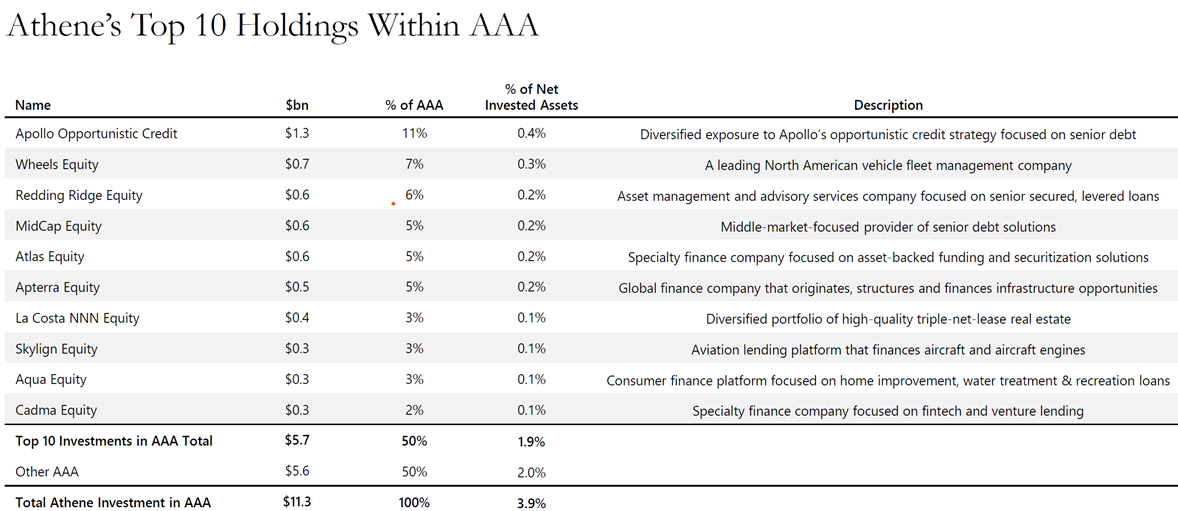
The AAA investments are entirely Apollo originated. Below are three tables breaking down the AAA holdings. They aren’t perfectly comparable. I do the best I can with limited information, conflicting sources and black holes.
Table 1 is sourced from Athene’s statutory filing. All tables are comparable in amount - around $11.2B and there is a material overlap in indivdual holdings.
Table 1: Statutory Filing, AAA Holdings in Schedule BA
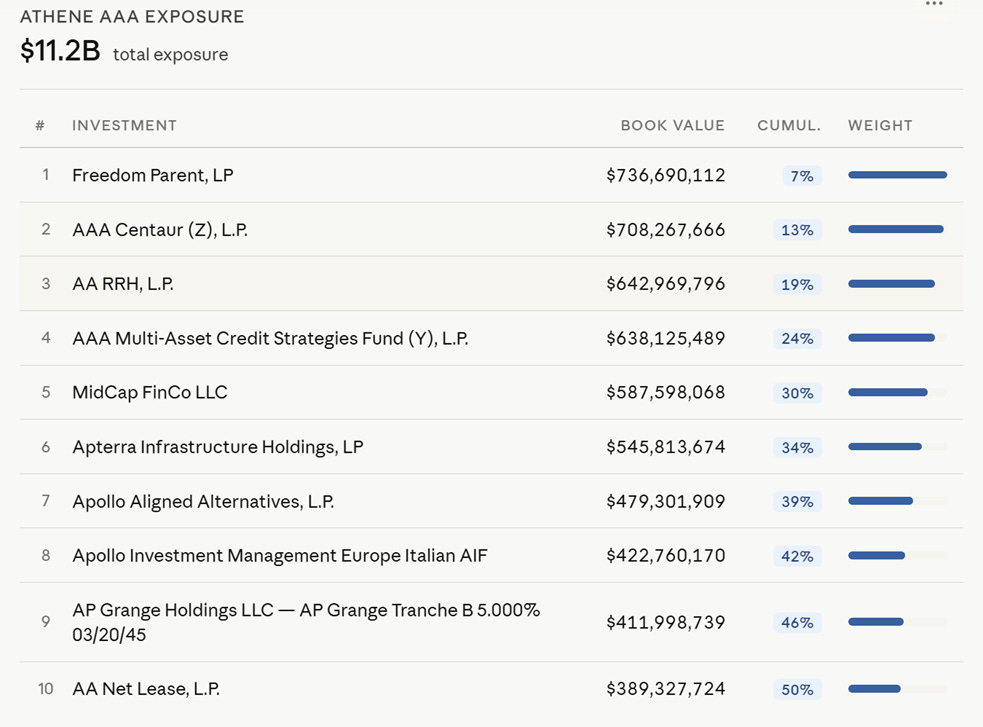
Table 2: AAA Breakdown in the10K
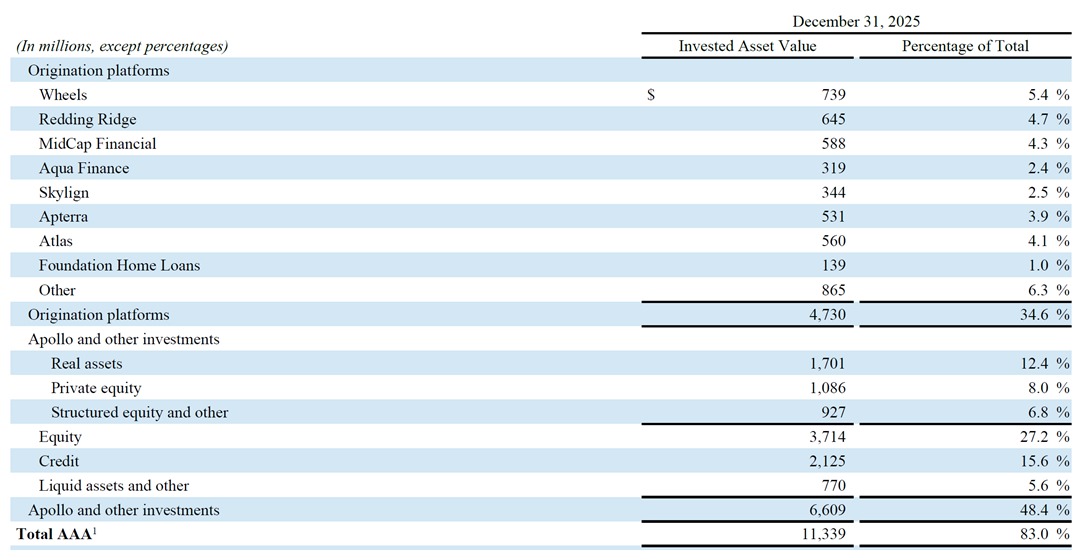
Table 3: May 2026 Alternatives Presentation
In addition, to the AAA holdings listed above, Athene has $1.5B alts exposure to two Apollo affiliated insurers - Athora and Venerable. Discussion of these entities is outside the scope of this article.
The largest holding in Schedule BA is Freedom Parent which I believe is the legal entity holdings Wheels, a corporate fleet vehicle leasing finance vehicle.
Aqua Equity is a consumer finance company specializing in financing water treatment installations, home improvement and RVs. Though owned by Athene, they don’t show up directly in Athene’s filing, but likely are held through one of Apollo’s nesting doll structures. In their most recent securitization, KBRA (a favorite of Apollo) assigned a AAA rating with 50% credit support. 50% credit support is very high and indicative of the riskiness of Aqua’s loan portfolio.
Aqua settled a lawsuit with the FTC in 2025 for mis-selling loans used for water filtering and treatment equipment. The below review is one of many, that perhaps indicate that Aqua’s problems continue:
“You will literally never pay off your loan with this company. Run. Go anywhere else. I was in the middle of a busy move and didn't read reviews first. If I had, I never would have gone through with this. Every negative review about this company is true! Be careful dealing with Aqua.”
Athene isn’t just exposed to Aqua via their equity ownership. They also own $1.1B in investment grade subordinated Aqua ABS securities.
This is a recurring theme illustrating how Athene goes all in on related party investments across the capital structure. Only by combining Schedule D and BA can one see the real aggregate exposure to these entities.
The third entity in Table 1, RRH, is an equity interest in Apollo’s Broadly Syndicated Loan lender and CLO manager, Redding Ridge. Athene not only has exposure to RR via AAA, they also own $3.5B in RR CLOs. And AAA’s equity interest in Redding Ridge is presumably subordinate to the CLOs.
Nevertheless, it’s important to consider the collective risk of Redding Ridge - the equity in RR + CLO Holdings are a very highly correlated risks.
Similarly, Athene’s aggregate exposure to their middle market lender MidCap is $1.9B, including the AAA equity and CLO investments. MidCap also owns a BDC.
In a recent article, I detailed the troubling circumstances around MidCap’s upgrade from junk to investment grade overnight. This trick was manufactured by Apollo’s firing of two rating agencies that assigned junk ratings to MidCap and adding KBRA who assigned a Single-A rating and somehow convincing Moody’s to upgrade MidCap 5 notches from Single B1 to Baa2.
If MidCap is junk rated, the equity owned by Athene/AAA is far riskier than if MidCap was truly IG, as was the case following the recent immaculate conception. And is there not a better example of why you should be skeptical of the notion of “investment grade” private credit when the ratings can be so easily manipulated?
The 7th largest AAA exposure is Apollo Aligned Alternatives, L.P. Yes one of AAA’s largest investments is another AAA entity - Russian Nesting Dolls in action.
In the 10K (Table 2) Athene categorizes AAA investments as “Origination Companies” and “Apollo and Other Investments.” The latter is more than 50% of the total and includes such unhelpful subcategories as “Real Assets” and “Structured Equity.”
The largest investment in the May report as shown in Table 3 above, is a fund called Apollo Opportunistic Credit which alone is over 10% of AAA’s holdings. No indication of the risk. It’s possible that those investments show up on the Schedule BA filing in several subcomponents – more nesting dolls. Or it’s possible that it represents new exposure since year-end.
While diving in the rabbit hole that is AAA, one thing seems clear - AAA’s Origination Companies are likely highly leveraged, asset-lite, entities with a large dependency on earnings thrown off by the leverage at the entity level. Aqua, Wheels, MidCap, and Redding Ridge are all at least partly financed via securitizations – either ABS or CLOs. Much of which is also owned by Athene.
Athene’s $4B surplus at risk
Equity in a highly levered company can easily be wiped out. In a severe recession it wouldn’t be surprising to find that a large swath of Athene’s $11B AAA investment are vaporized.
Though BA investments typically require 30% capital, that may not be enough (in fact the NAIC recently increased it to 45% for certain Schedule BA investments). Bank investments in residual/equity type investments often require dollar for dollar capital - eg 100%.
Apollo downplays the risk of AAA’s equity investments
In Apollo double speak – these investments have “equity like returns with downside protection” – the latter is doing heavy lifting to downplay the very real risk of these equity-like investments.
Athene claims that 80% of AAA assets are “predictable/contractual cashflows.” It’s difficult to validate this but these are largely characterized as equity investments, which inherently are not contractual cashflows. Perhaps they are referring to equity investments that throw off management fees and residual interests in securitizations. Regardless, the characterization seems rather generous.
Call me cynical but I’m going to go ahead and say equity like returns can’t be achieved without equity like risk. Full stop. Let’s not pretend otherwise.
AAA Apollo Conflicts Revealed
The cynical reader (IE informed reader) wouldn’t be too surprised to learn that Athene’s Board members and executives have holdings in the AAA assets. The conflicts of interest are absolutely out of control:
“Certain members of our board of directors and certain of our executive officers may directly receive carried interest or may receive a portion of the carried interest that Apollo receives from fund investments in which we are invested. Certain directors may invest in fund investments in which we have invested. Additionally, Mr. Belardi also has interests in certain of these fund investments. Certain directors and officers from time to time may invest in Apollo funds or co-investments in certain cases without being charged management fees or carried interest.”
Coming in Part 2
In the next day or so I will be publishing Part 2. That article will focus on another $12B or so Apollo originated investments that are mostly backed by Equity but treated as Investment Graded Debt from a capital standpoint. Given the limited capital, these investments may present even more risk to Athene, than AAA.
Stay tuned….
Hi. Just on the cayman thing as I saw you brought that up elsewhere. Isn’t domiciling a fund in cayman just categorically different than the issue Rowan has been vocal about? I.e., he has been talking about shifting policy liabilities to a jurisdiction where you are required to hold less capital and can own any assets you want against them. Having a fund LP domiciled in Cayman is just fundamentally different no? Like if I set up a fund in cayman and you are my LP I don’t see how that would be hypocritical about any commentary on reinsurance to the Caymans. Curious if something obvious I’m missing there
For what it's worth, AAA is apparently going to be the private-markets sleeve of a series of State Street target-date funds intended for 401(k) default investments, comprising 10% of the TDF across its entire "glidepath." https://www.ssga.com/us/en/institutional/capabilities/dc-overview/target-date-funds/state-street-target-retirement-indexplus-strategies