


This article fuses together three stories related to AI, data center and private credit/equity bubbles. They can be read individually without loss of continuity. Perhaps the final story about Fermi is most astounding.
PIMCO and Blue Owl – the ties that bind
Is there another story behind PIMCO’s bold takedown of Blue Owl’s BDC debt?
PIMCO made headlines last week by buying the entire offering of Blue Owl’s OBDC debt. This gave Blue Owl a sorely needed vote of confidence in light of the recent barrage of negative headlines and Owl’s shares soared 17% in response.
While it’s likely that PIMCO simply found the offer attractive, there is another Blue Owl - PIMCO relationship that may have contributed to PIMCO’s Blue Owl lifeline. Last year, PIMCO bought most of the $27B Meta data center infrastructure deal, in which Blue Owl plays several critical roles. The issuer of the debt was Beignet LLC.
While Meta serves as the developer and operator, Blue Owl is the linchpin for the project’s unique financial structure:
1. Majority Ownership: Funds managed by Blue Owl Capital own 80% of the joint venture, while Meta retains only 20%.
2. Capital Contribution: Blue Owl contributed approximately $7 billion in equity to the project.
3. Debt Issuance: Blue Owl manages the SPV that issued the massive $27B debt.
4. Off-Balance-Sheet Strategy: By partnering with Blue Owl, Meta was able to issue this debt without carrying the full debt on its own balance sheet, thereby preserving its credit rating.
5. Landlord: Blue Owl effectively acts as the landlord; Meta will lease the facilities back from the joint venture under long-term operating leases once construction is complete in 2029.
Given the critical roles of Blue Owl in the Meta transaction, it’s reasonable to wonder whether Blue Owl’s troubles put the valuations of the Beignet debt at risk.
While I don’t know who currently owns the entirety of the $27B Beignet debt, I found $5B owned by PIMCO’s flagship Income Fund.
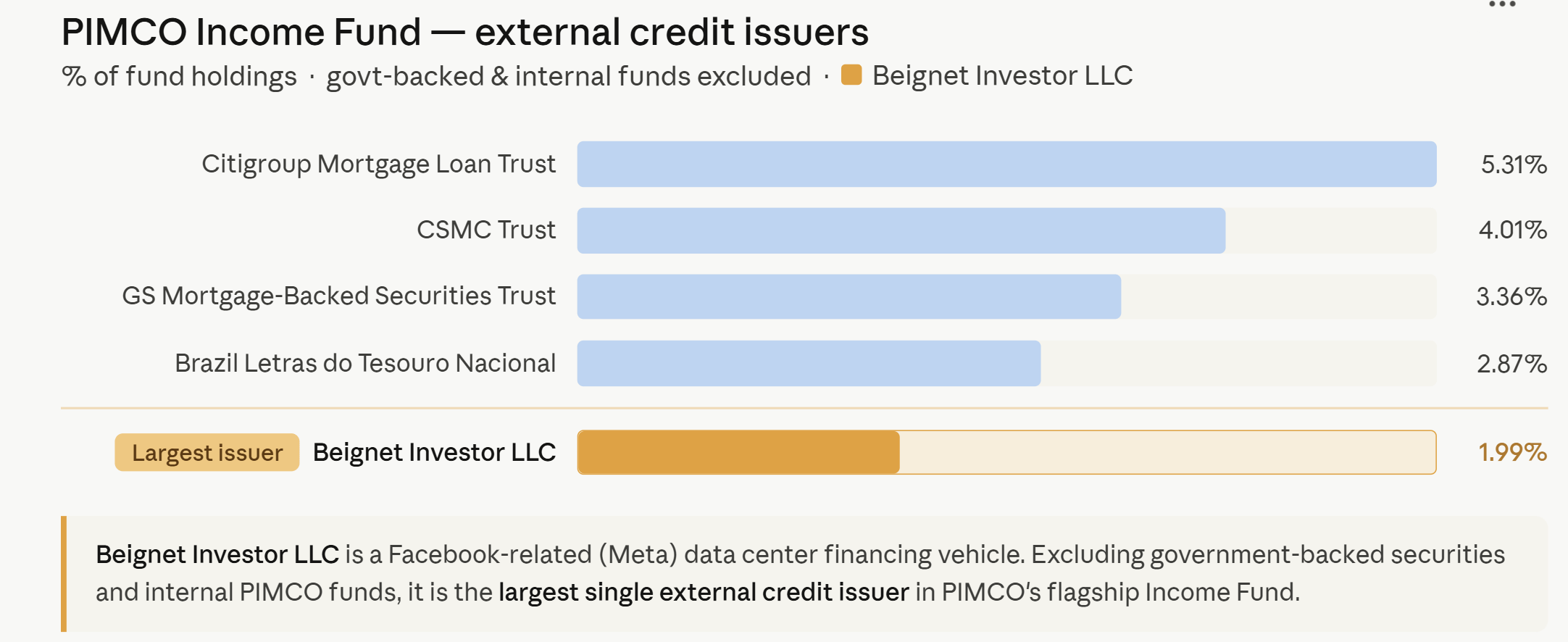
As the image shows, the Beignet debt represents one of PIMCO Income Fund’s largest non US government exposures at 2% of net assets. PIMCO also owns the Beignet debt in other funds.
It’s important to note that there doesn’t appear to be direct credit exposure to Blue Owl and operational control of the actual data centers is with Meta. However, given Blue Owl’s troubles and the various critical roles Blue Owl has in the Meta deal, it’s possible that PIMCO’s buying of the Blue Owl BDC debt and the subsequent Owl shares rally has a positive knock on effect of the valuation of the Beignet debt.
In other words, the $500M BDC deal may have helped PIMCO’s much larger $5B+ Meta/Blue Owl exposure.
Whether the two transactions were linked in PIMCO’s decision making I can’t say. But I believe it is important context to consider in light of the fact that the BDC debt purchase helped clear some dark clouds over Owl.
In short, there may be more to the story.
Full disclosure: I previously worked with the PIMCO team managing the PIMCO Income Fund. It is a savvy team.
The Great AI Credit Risk Laundering: Meta Case Study
Meta’s $27B data center investment in partnership with Pimco and giant Blue Owl was a massive investment funded mostly with debt.
The structure of the debt offering is a great example of credit risk laundering, courtesy of rating agency Standard and Poor’s.
The deal structure is a complicated off-balance sheet beast involving rolling leases funded via a special purpose entity. All you really need to know is this: S&P gave this huge deal an A+ rating and noted that they leaned heavily on Meta’s own AA- rating.
The more credit S&P gives to Meta in supporting the debt, the more they should include the debt in Meta’s own rating and therefore downgrade Meta. But they didn’t.
With outstanding debt of $58B, this transaction would have added nearly 50% to Meta’s debt load. But thanks to S&P’s magical math this massive debt is at the same time kinda sorta guaranteed by Meta but somehow not an obligation of Meta.
Beyond the Meta guarantee that isn’t a guarantee, S&P notes some fairly material risks:
“Certain unavoidable costs for idle buildings could hurt the DSCR profile. However, this risk will only arise if there is a substantial destruction in global AI-driven demand or substantial overbuilding of data centers capacity globally, which causes Meta to not buy facilities at a nominal price (even $1) …”
“The security package is relatively weak due to financing at the JVCo partner level. ... the lenders lack direct security over the project assets...”
Sounds pretty risky to me for an A+ rating. But there is the Meta guarantee. That isn’t a guaranty.
The leviathan data center bet has huge risks
This bet is based on the assumption that AI quality is correlated to the quantum of hardware. Many experts question whether current AI models (i.e. LLM) have much juice left in the orange. What if scaling AI isn’t about scaling hardware? Or the hardware requirements change? Or what if the demand isn’t there? Or the revenue model doesn’t materialize?
In addition, there is a growing backlash to data centers due to environmental and utility cost concerns. According to Data Center Watch: “In 2025, local opposition blocked or delayed dozens of data center projects representing $152B in potential investment.”
Meta themselves have had limited traction with their AI/LLM models and lost their AI lead Yann LeCun late last year, who has long doubted whether LLMs were the right approach to developing the Holy Grail of Artificial General Intelligence (AGI).
And does everyone remember the tremendous success Meta had with their last big bet? Nope. Because it was a spectacular, epic failure. With their Metaverse folly, Facebook basically threw $80B on a bonfire. Maybe they will be more successful with this bet. Don’t bet on it.
When it comes to AI bubbles though, nothing compares to Fermi.
Fermi – The Most Insanely Hyped AI Deal on the Planet
Leadership ousted this past Friday
Fermi is no Meta in terms of name recognition or balance sheet, but it planned to build the largest data center in the US.
Before a dollar was earned or a contract signed, Fermi was a unicorn worth over $1B in its early days and went public as a REIT, valued at $12B, peaking at a valuation over $16B (yes a $12B IPO without a dollar of revenue or a single contract).
On what basis does the SEC approve such an IPO? Or is that not a thing any more?
Not in the everything bubble.
Fanciful dreams and political connections
Fermi touted plans to build a 17 GW data center in Texas and featured close ties to the White House, even naming the facility “The President Donald J. Trump Advanced Energy and Intelligence Campus.” I kid you not. It slowly migrated to its more commonly known and more prosaic name - Project Matador. But I’m sure they still use “The President Donald J. Trump Advanced Energy and Intelligence Campus” in certain circles.
Fermi’s founding partners included political luminaries such as Rick Perry, Energy Secretary under Trump 1.0 and Toby Neugebauer (who was also the CEO), son of former Texas Congressman Randy Neugebauer.
And let me refresh your memory on Mr. Perry. During a debate when running for President (of the United States) he was asked which of three federal agencies he would shut down (it was one of his key campaign promises). He could only remember 2. Well as the great Meatloaf said, 2 out of 3 ain’t bad.
For an idea of how insane the 17GW data center is, OpenAI’s massive data center Stargate had announced power capacity of 10GW and Meta’s Hyperion data center, had announced power capacity of 7.5GW. But because Fermi projected revenue on a per GW basis, why not push the gigs to the max when going for an IPO before you’ve earned a single penny or signed a single lease.
Because these are the times we live in.
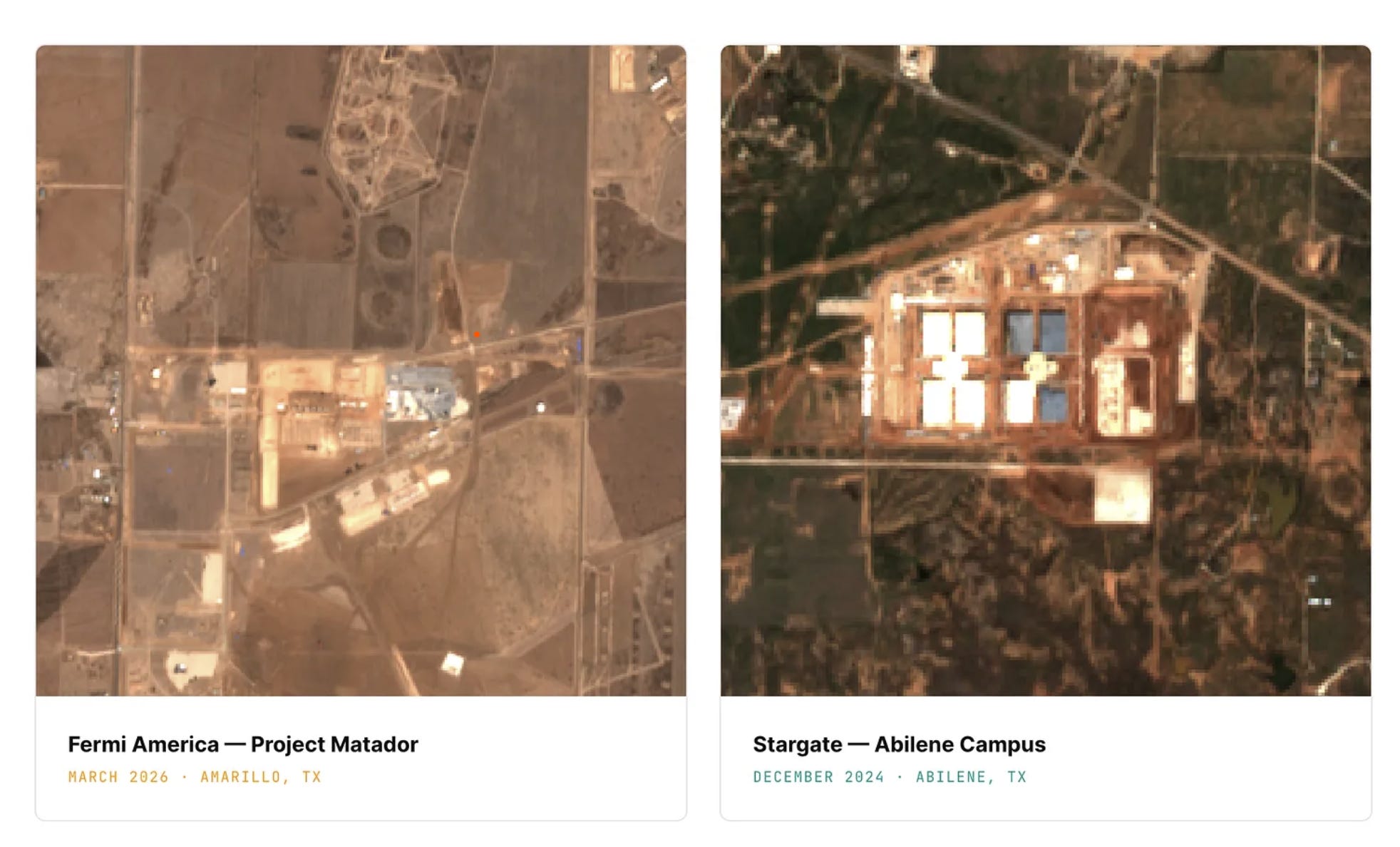
See the images below which compares OpenAI’s Stargate datacenter progress to Fermi at a comparable point in time. Fermi is still largely a patch of dirt. A formerly $16B patch of dirt.
See this article for more images.
Ch ch Changes
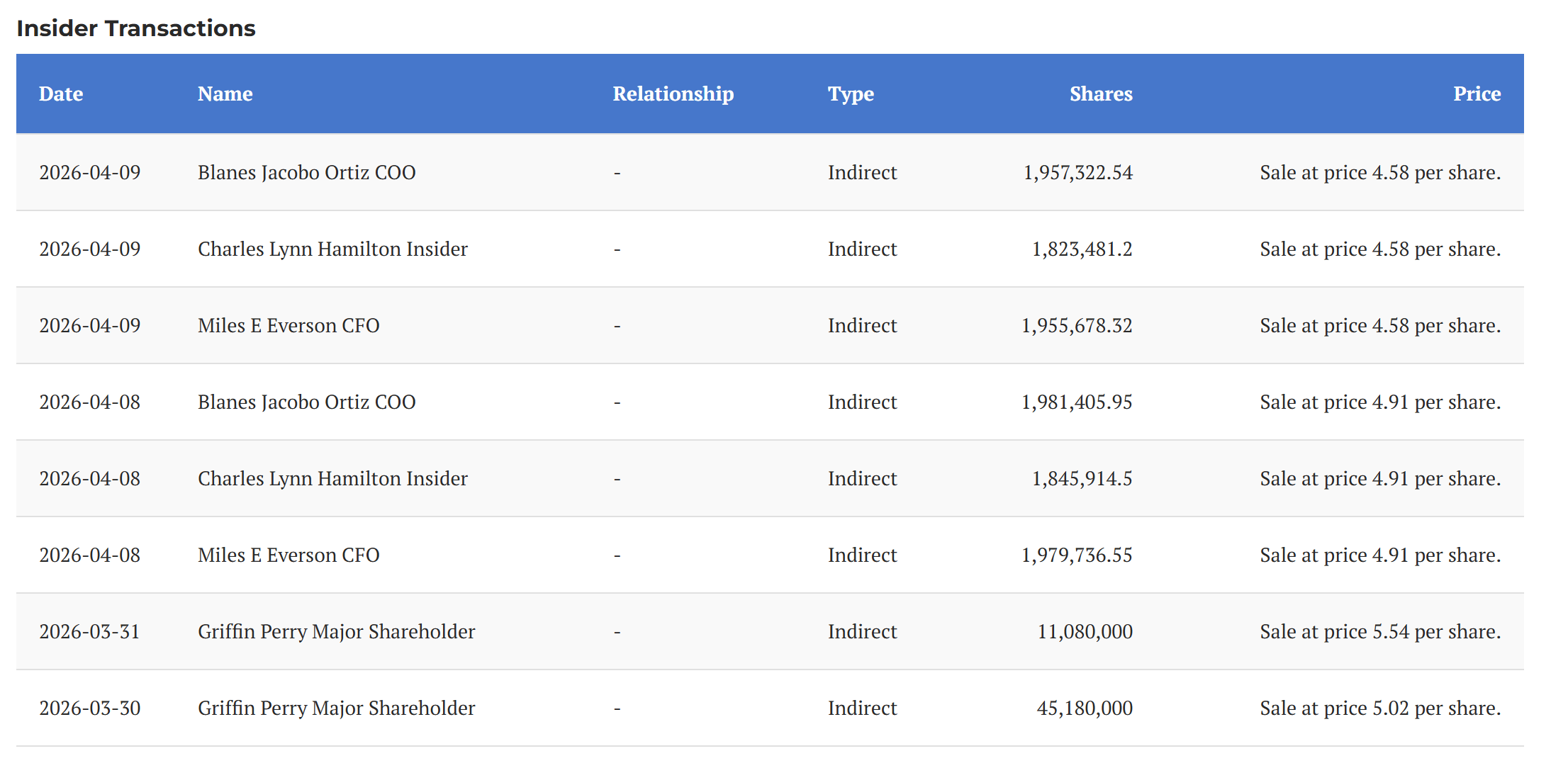
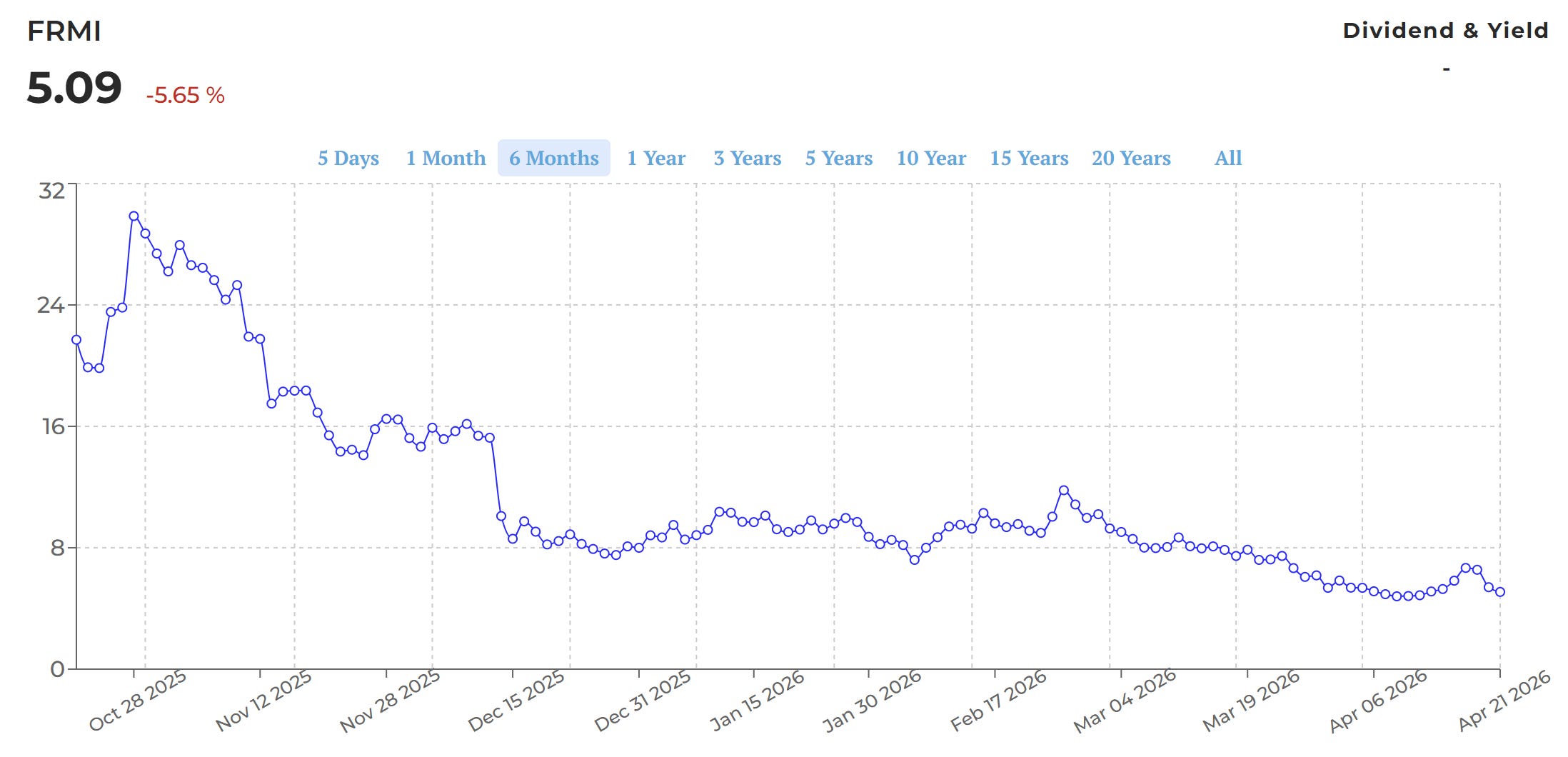
On Friday Mr. Neugebauer was out as CEO as was the CFO. The value since IPO? Down 70%.
You can see below the tell tale signs of a bubble bursting - the dual red flags of stock price collapse and millions of shares in insider selling. Oh and note the sale from Griffin Perry. He is the son of cofounder Rick Perry. When a cofounder’s son is selling, maybe everyone should be.
Images from our equity dashboard tool
Allianz in different Pimco Funds (Total Return, Income…) has USD10.2bn of the debt
From 10/21/25 WSJ article on the financing:
BlackRock bought more than $3 billion of bonds issued last week to finance the data center, which is called Hyperion, according to people familiar with the matter. The project is 80%-owned by private-credit manager Blue Owl Capital OWL 0.96%increase; green up pointing triangle, while Facebook parent Meta owns the remaining 20% stake, according to S&P Global Ratings. The bond sale was arranged by Morgan Stanley.
-----------------------------------------------------------------------------------------
Pimco, the giant bond manager, was the biggest buyer, accounting for $18 billion, people familiar with the matter said. The bonds were priced at face value of 100 cents on the dollar last week. By Monday, BlackRock’s funds had valued them at 110.2 cents, implying large paper gains for investors that initially participated in the transaction.
-------------------------------------------------------------------------------------------
I've respected PIMCO for a long time and recently purchased a bit of PAXS. But $18 billion??